
I’ve often asked myself just what I think I would like most in this world. Surprisingly I found that when the question is asked every 10 years, in my case it seemed to yield similar answers every time asked. I know we have selective memories and that we can often betray our own senses, but when looking back through all the years I have witnessed, there are only a few truly codifying moments for me to reveal.
What is it that we want more than anything else in this world?
To answer this question I went back in time to ask myself just what I thought at different ages in my life. I used a very special time machine for this purpose to collect my information. This time machine is an elaborate instrument that has more neural connections than the known stars in the sky. There is no exact number, as most neurons are too tiny to be viewed with a microscope, but conservative estimates put it at least 1 trillion (10^12) connections in the brain alone.
Take the optic nerve for an example – this is one nerve that runs from the eye to the brain and is responsible for sight. There are 1 million neurons in this particular nerve alone – so each neuron has 999,999 potential partners – but it must meet with its exact partner out of 1,000,000 for vision.
Thus, this time machine I call upon produces the memories that populate my mind and sends me back to the time I wish and I ask myself just what it is that I wanted? After I reviewed the most popular 3 answers for each time I asked this question, there was always one that stood out which you see below.
- 7 Year Old: The love of my parents and brother
- 17 Year Old: The friendships and acceptance outside of my family
- 27 Year Old: Starting my own family
- 37 Year Old: The love and acceptance from my daughter
- 47 Year Old: The acceptance and forgiveness of myself
It is an interesting set of answers to an interesting question that spans forty years and demonstrates the quintessential desire in human relationships for me at least. Of course these are based on my circumstances for each time, my disposition toward the world for each time, my personality and ego’s assessment at each time, and a subconscious presence in these times were evaluated for content in those contexts. I chose to begin with the age of seven years old because around that time I have memories that began to question such matters.
The notion that memories can be considered as mental time capsules; a snapshot of time that you can again review is as sound as the memory if indeed the memory is stored accurately. The truism that I am exploiting may just have a duel edge; one that can teach us a history lesson (if we have learned it), or one edge that defies the lesson we still need to earn.
For me I am fortunate to have sources other than my memory. The memory of my friends, family, and that of my journals can give much information when asking the right questions. What I found to be striking is the preoccupation with this topic of how I fit into the social arena. I am perplexed at the matter because on a casual observation, it seems that I am just that, ‘preoccupied’ with those around me, or how I seem to relate to them. But further analysis indicates that I have a fundamental disconnection with some of the people in my life, that I am searching and have always been searching for a greater metaphysical connection than what I have been able to make during this time in my life. I do not take into account the material wants, as I seek a deeper question that involves more than this physical world can provide for us. I edited my answers above with this in mind, and I am left with still a perplexing question for anyone to consider.
It is the reason for my Enneagram personality and orientation to the world growing up as a small child. It is the reason for the disposition in my relationships through-out much of my life and the yearnings for deeper connections. It is also responsible for much of how I handled and mishandled the emotional events and the coping strategies used when going through my personal endeavors.
You can take any life and extract out of it any meaning you wish to make a case for, but for me, I am, and always have been one that has sought out some measure of truth I can feel deeply. Not a religious experience, or beliefs that will satisfy a mind’s logical analysis, but rather to engage in a deeper experience that is felt in your entire being. Much talk of this is found in many religions, and from many mystics around the world. For reasons I do not completely understand, I have a need to open the doors that have not yet opened for me. I somehow feel there is more than what I am allowing myself to see given my disposition.
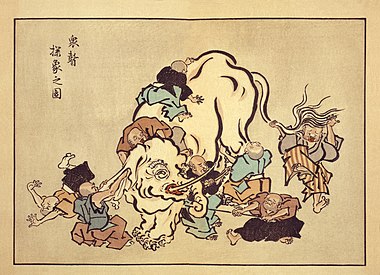
It is that reason that I have always looked but have not yet found in the course of my life. I am like one of those blind men in the parable of the elephant….
In the Udana (68–69)[7] the Buddha uses the elephant parable to describe sectarian quarrels. A king has the blind men of the capital brought to the palace, where an elephant is brought in and they are asked to describe it.
When the blind men had each felt a part of the elephant, the king went to each of them and said to each: ‘Well, blind man, have you seen the elephant? Tell me, what sort of thing is an elephant?’
The men assert the elephant is either like a pot (the blind man who felt the elephants’ head), a winnowing basket (ear), a plowshare (tusk), a plow (trunk), a granary (body), a pillar (foot), a mortar (back), a pestle (tail) or a brush (tip of the tail).
The men cannot agree with one another and come to blows over the question of what it is like and their dispute delights the king. The Buddha ends the story by comparing the blind men to preachers and scholars who are blind and ignorant and hold to their own views: “Just so are these preachers and scholars holding various views blind and unseeing…. In their ignorance they are by nature quarrelsome, wrangling, and disputatious, each maintaining reality is thus and thus.” The Buddha then speaks the following verse:
O how they cling and wrangle, some who claim
For preacher and monk the honored name!
For, quarreling, each to his view they cling.
Such folk see only one side of a thing.[8]
The Moral….
“We have to remember that what we observe is not nature in itself, but nature exposed to our method of questioning.” – Werner Heisenberg
Therefore one must ask the right questions and out of that reasoning comes my metaphysical problem which can lead one to break through the reasoning barrier by uniting with another human intention and energy of perception. Hence my lifelong solution may just lie within my perceptive abilities. Abilities such as the mystical encounters by which many may have transitioned over their rational realms to reach a deeper understanding given their conditioning. A psychic gap bridged by other features of our experience in this world, one that can be ‘felt’ and not just thought!
This gives a whole new outlook when rereading works such as …
For the obvious reasons my search is still on. Differences on how we learn best is evident in many of the studies I have read that can be found in the current psychological literature. Some people are more verbal, some are more tactile, some are more visual, and some are more abstract, et cetera, so by virtue of this analogy I may have not done justice to the materials I was working with on a very rational level. My accounts must also seed my other inner senses to fully grasp an experience in this life that appreciates much more of it. I must also live in the practice of undoing my former conditioning that prevents me from aligning with a deeper self, one that ‘knows’ it is connected to all that is around. The bridge I build is one for the heart, one that will further my journey into discovery.
a post dedicated to LLW


You must be logged in to post a comment.